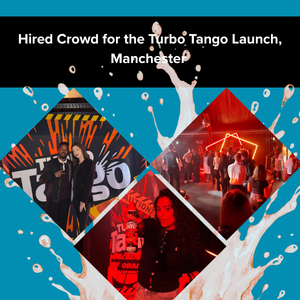
Case Study: Crowd Talent for the Turbo Tango Launch, Manchester The Project A product launch…
What Makes a PR Stunt Go Viral on Social Media?
Ask any PR team what they want from a stunt, and you will hear the same answer every time: something that gets people talking, something that spreads on its own without needing a huge media budget behind it. What you will not hear is a reliable formula for making that happen, because if one existed, every campaign would go viral and none of them would feel special anymore. Still, when you look closely at the stunts that genuinely broke through over the years, certain patterns keep showing up. None of them guarantees virality on their own, but ignore enough of them and a stunt is almost certainly going nowhere.
The first thing worth saying is that budget is not the deciding factor most people assume it is. Some of the campaigns that travel furthest cost relatively little to stage compared with the coverage they end up generating. A well-cast, well-briefed crowd of the right people, in the right place, doing something visually simple, will often outperform a stunt with far more production spend behind it. Money buys polish. It does not buy an idea worth sharing, and it does not buy the moment on the street that makes a stranger stop and take a photo.
People Share What They Can Understand in a Glance
The stunts that spread fastest tend to be the ones a stranger can understand without any caption at all. Take the crowd of Boris extras we put together for Oxfam a while back. Six men dressed as Boris Johnson, briefcases in hand, walking through central London towards Westminster Bridge, each case spelling out a message about British bombs and the Yemen crisis. Nobody passing on the street needed the campaign explained to them. The image did the work on its own, a slightly absurd, slightly serious sight that people wanted to photograph and post before they had even worked out exactly what it was promoting. That is the whole trick really: giving someone something they can grasp in a glance and want to share before they have thought about why.
This is probably the single most common mistake PR teams make when a stunt does not land the way they hoped. Somewhere in the planning process, a simple idea picks up extra layers, an additional message here, a secondary objective there, until what started as one clear hook becomes three half formed ones competing for attention. Every one of those additions feels reasonable in a meeting room. Out in the real world, on a phone screen, competing against everything else fighting for someone’s attention that day, complexity is just friction, and friction kills sharing.
The Image Has to Do the Talking
Social platforms are still, at their core, visual spaces, and stunts that give people something genuinely striking to look at tend to outperform ones that rely on a clever premise alone. We saw this first hand with a crowd of body-confident ladies we hired for a PR agency working on behalf of a holiday company. Thirty real women, not models, spent a day on a beach built specially in Salford for National Bikini Day, and the campaign went on to be shortlisted for a PR Week award. The image alone told the story: ordinary women of every shape enjoying themselves without a filter in sight, which is exactly the kind of picture that gets shared precisely because it looks so unlike everything else scrolling past it on a feed.
What both of those campaigns point to is how much weight sits on the physical staging of a stunt, not just the concept behind it. A strong idea that gets thrown together on the day, with a thin crowd, poor positioning or nobody thinking through how it will actually look on camera, rarely produces footage worth sharing, no matter how good it sounded on paper. Getting that part right is really the whole reason a business decides to hire a crowd rather than try to pull people together informally, because the difference between a convincing scene and an awkward one usually comes down to experience, briefing and the calibre of the people standing in it.
Timing Rewards the Brave
Some of the biggest social wins are not planned months out at all. They happen because a brand or a campaign spots something already bubbling in culture and moves on it fast, before the moment passes. The Oxfam stunt worked partly because of that same instinct, taking a serious political message and finding a moment that was culturally live enough to make people stop and engage with it rather than scroll past another straightforward press release. That kind of speed asks a lot of a PR team. It means legal sign off that does not take a week, creative decisions made in hours rather than days, and a willingness to accept a bit of risk that plenty of more cautious brands never quite get comfortable with.
Audiences are surprisingly sharp at telling a genuine reaction from a manufactured one. There is something about a stunt that feels put together with real energy, rather than polished within an inch of its life, that people respond to more warmly. It is a slightly uncomfortable truth for anyone used to months of planning cycles, but the stunts that feel alive tend to beat the ones that feel produced.
It Still Has to Sound Like the Brand
Even a beautifully staged, perfectly timed stunt can fall flat if people sense it does not actually belong to the brand behind it. The body confident beach stunt worked because it was tied to a holiday company selling exactly the kind of experience those thirty women were shown enjoying, so the message and the picture reinforced each other rather than fighting for attention. Try the same idea attached to a brand with no obvious connection to travel, wellbeing or body confidence, and the reaction online tends to be sceptical at best. People can tell the difference between conviction and opportunism, and social media has become a fairly unforgiving place for anyone caught faking the former.
This is worth remembering whenever a bold creative idea starts circulating in a planning meeting. The question is rarely just whether it will get attention. It is whether the idea connects to something true about the brand. Ideas chosen purely because they look shareable on a slide, with no real link back to the brand’s history or values, tend to be the ones that generate the wrong kind of conversation once they go live.
Feelings Travel Further Than Facts
Nobody shares a stunt because it was well produced. They share it because it made them feel something, and that feeling is doing more of the heavy lifting than most campaign strategies give it credit for. The body confidence beach day hit an emotional nerve precisely because so many women recognised themselves in it: the quiet frustration of feeling like a beach or a bikini was only for a certain body type, and thirty real women having a genuinely good day pushed back against that in a way no product advert ever could. That emotional recognition is what turned a fairly simple day out into a campaign people wanted to talk about and, eventually, an award nomination.
Humour works similarly, particularly when it does not feel like it is trying too hard. Six men in Boris wigs solemnly carrying briefcases across Westminster Bridge is, on paper, a slightly silly image, yet it worked because it made people smile and look twice, and that flicker of amusement is often enough to make someone tap share without thinking too hard about it. The common thread between the emotional stunts and the funny ones is that the feeling always arrives first, with the brand message trailing quietly behind it rather than leading the charge. Force that order the other way round, message first, feeling second, and the whole thing tends to feel hollow no matter how much effort went into it.
Where It Usually Goes Wrong
It is worth spending a moment on failure, because it teaches you almost as much as the successes do. Stunts tend to underperform when the brand insists on explaining its own cleverness rather than trusting the audience to get there on their own, or when a genuinely good idea gets undermined by weak execution on the day, a scene that looks sparse or awkward once it is actually filmed. Bad timing sinks plenty of otherwise decent concepts too, whether that means launching a moment after the cultural window has already closed or simply misreading how people are feeling at that point.
Crowd management deserves more credit as a point of failure than it usually gets. A stunt that photographs as thin or half-hearted undermines everything the concept was trying to achieve, no matter how sharp the original idea looked in the brief. This is really where the practical side of a stunt, the actual people involved and how convincingly they hold a scene, decides whether footage ends up worth sharing at all. A great idea staged with a handful of bored-looking extras standing awkwardly in the background rarely produces the moment everyone was hoping for, which is exactly why the businesses who do this well tend to hire a crowd through people who know how to brief, manage and hold a group on the day rather than leaving it to chance.
Getting the Real World Part Right
Every genuinely viral stunt shares one final thing in common, and it has nothing to do with cleverness. The idea and the execution mattered equally. Someone still had to stand on that bridge and stay convincingly in character despite the stares, or spend a full day on a fake beach in Salford looking relaxed and genuine rather than like they were performing for a brief. That is often the small, unglamorous detail that separates a stunt people believe in from one they can spot as fake within seconds.
Rentacrowd UK works alongside PR agencies and brands across the country to bring exactly that side of a stunt to life, supplying professional actors, extras and crowd talent who understand what a camera actually needs to capture a moment believably. Whether a concept calls for a big, energetic crowd to give a stunt real scale, like the beach day in Salford, or a small, tightly briefed group who can hold character in public for hours on end, like the six Borises walking through Westminster, getting the people right is usually what turns a good idea on paper into something people genuinely want to share.

Related Posts